

Why Choose Artisan Silver Over Mass-Produced Jewelry
Table of Contents
- The Real Difference Between Artisan Silver and Factory Jewelry
- Artisan vs Mass Produced Jewelry Pros and Cons
- How to Identify Quality Silver Jewelry
- The Benefits of Handmade Jewelry That Lasts
- Why Artisan Silver Costs More (And Why It's Worth It)
- Investment Value and Resale Potential
- Conclusion
- Frequently Asked Questions
Last Updated: September 20, 2026
The Real Difference Between Artisan Silver and Factory Jewelry
Artisan silver is jewelry shaped by a single maker's hands, one piece at a time, while mass-produced silver is stamped out by machines in volume, often thousands of identical units per run. That difference shows up in weight, details, and how long a piece lasts. This guide from Inner Wild Jewelry breaks down where each approach wins, so you can decide what belongs on your wrist.
Artisan vs Mass Produced Jewelry Pros and Cons
Both methods have real trade-offs. Mass production wins on price and availability; artisan work wins on durability, character, and long-term value.
Where Mass Production Wins
Cost and speed are the two genuine advantages. A factory casting thousands of identical rings spreads its tooling costs across the entire run, so each unit costs less to make. That savings reaches you at checkout.
- Lower upfront price: machine casting and automated finishing cut labor per piece
- Instant availability: no waiting for a maker to complete your order
- Consistent sizing: every unit in a run measures identically
- Easy replacement: if a piece breaks, an identical one is usually in stock
Where Artisan Silver Wins
Handcrafted pieces are built one at a time, so the maker catches flaws a production line would miss. A silversmith solders, files, and polishes each joint by hand, then checks weight and balance before it ships.
- Heavier, sturdier construction: more metal where stress points need it
- Hand-finished details: stamping, hammering, and bezels set by eye and hand
- One-of-a-kind character: no two pieces are identical
- Repairable design: solid construction can be resized and restored
| Factor | Mass-Produced Silver | Artisan Silver |
|---|---|---|
| Upfront cost | Lower | Higher |
| Production speed | Fast, high volume | Slow, small-batch |
| Construction | Often hollow or thin | Solid, weighted |
| Uniqueness | Identical units | One-of-a-kind |
| Repairability | Limited | Good |
| Long-term value | Low resale | Holds value better |
How to Identify Quality Silver Jewelry
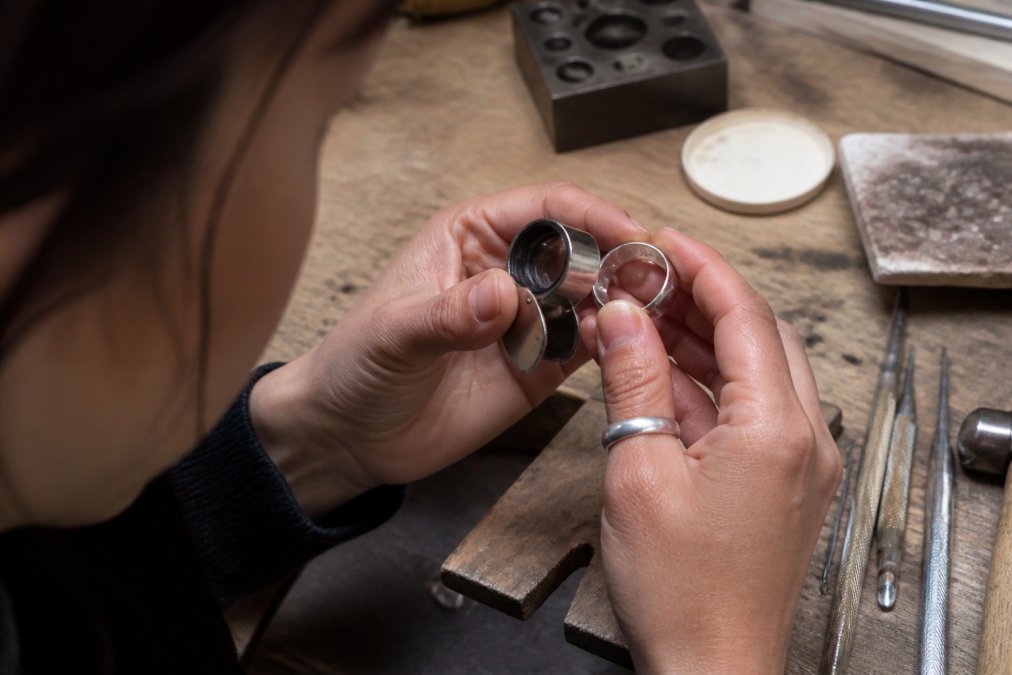
Quality silver jewelry carries a purity stamp, feels heavier than it looks, and shows clean, hand-finished detail rather than a uniform machine polish. Learning how to identify quality silver jewelry takes about two minutes, but the real tells are metallurgical.
Sterling vs. Fine Silver: What the Numbers Mean
Silver purity is measured in parts per thousand, and the stamp tells you exactly what you're holding.
- Fine silver is 99.9% pure, stamped "999" or "Fine Silver." It's the softest form, tarnishes more slowly because there's almost no base metal to react, but it dents and scratches easily. Most fine silver shows up in small pendants, ear wires, or bezels rather than structural bands.
- Sterling silver is 92.5% pure silver and 7.5% other metal, almost always copper. That alloy is what gives a cuff or bangle the spring and hardness to hold its shape against daily wear. It's stamped "925," "Sterling," or "Sterling Silver."
- Coin silver is 90% silver, historically common, now rare in new jewelry. If you see "900" on a modern piece, ask why.
Casting vs. Fabrication: The Construction Tell
Two pieces can both be stamped "925" and still be built in completely different ways.
- Cast pieces are made by pouring molten silver into a mold. This is how most mass-produced jewelry is made. Casting is fast and cheap, but the resulting metal is slightly more porous, and thin cast sections crack rather than bend.
- Fabricated pieces are built from sheet, wire, and tubing that the maker cuts, forms, solders, and finishes by hand. The metal is denser and work-hardened at the stress points, which is why fabricated cuffs and rings survive resizing and reshaping.
Reading the Hallmark Correctly
The Federal Trade Commission's guidance on jewelry marketing requires accurate disclosure of precious metal content, so a stamp is a legal claim, not decoration. But a stamp alone doesn't tell the whole story.
Here's what to check, in order:
- Find the purity mark. "925," "Sterling," or "Sterling Silver" on the inner band, clasp, or back of a pendant.
- Look for a maker's mark. A stamped initial or logo next to the purity mark means a named maker stands behind the piece. Its absence is a yellow flag on anything sold as handmade.
- Weigh it in your hand. Sterling has heft. A hollow piece of the same outer dimensions feels noticeably lighter and tinny.
- Inspect the joints under good light. Hand-soldered seams are smooth and slightly varied. Cheap welds look lumpy, and cast seams often show a faint mold line.
- Check the finish for variation. Hand-polished surfaces have subtle directional marks and slight unevenness. A perfectly uniform mirror finish usually means machine polishing.
- Test the clasp or cuff tension. A solid cuff holds its shape when you flex it. A thin one bends out of round and stays there.
The Benefits of Handmade Jewelry That Lasts
Handmade jewelry lasts longer because more metal goes into the stress points and the maker controls the whole build. A silversmith shaping a cuff by hand can thicken the band where it flexes and set a stone so it won't work loose.
Why Artisan Silver Costs More (And Why It's Worth It)
Artisan silver costs more because a human being spends hours on a single piece instead of minutes. Labor, small-batch production, and hand-finishing add cost that a factory run spreads across thousands of units. You're paying for time, not just material.
Investment Value and Resale Potential
Solid silver holds value better than plated or hollow jewelry, and handcrafted pieces from a known maker hold it best of all, but the reason is mechanical, not sentimental.
The Metal Floor
Every solid sterling piece has a baseline value tied to its silver content. A piece of known weight and purity can always be sold for at least its melt value to a refiner or metals buyer.
A solid sterling cuff has a worst-case value;
What Actually Drives Resale Above the Metal Floor
Melt value is the floor, not the ceiling. Above it, three factors move the price:
- Maker reputation. Pieces from a named, established silversmith sell for more than anonymous sterling of the same weight. Buyers search for specific makers by name, which creates demand that generic factory runs never generate.
- Scarcity. A small-batch or one-of-a-kind piece stays scarce by design. A discontinued factory run is technically scarce too, but nobody is hunting for it, so scarcity alone doesn't create value.
- Condition and repairability. A solid piece that can be polished, re-shaped, and re-soldered holds more of its value than a thin or hollow piece that cracks at the first stress. This is where construction quality shows up in dollars.
The Fast-Fashion Depreciation Curve
A well-made cuff from a known maker follows a different curve. It may not appreciate like a rare collectible, but it holds a meaningful share of its original price and can be passed down rather than replaced. A piece like the Bite Club - The Big One, built around a large fossilized shark tooth in a double hammered cuff, is the kind of statement piece people keep rather than flip, which is why the few that surface hold their value.

How to Judge a Piece Before You Buy
If resale matters to you, ask four questions before you spend:
- Is it solid sterling, or plated/hollow? Solid metal is the only kind with a resale floor.
- Is there a named maker? A maker's mark and a recognizable body of work support resale demand.
- Is the design signature or generic? Signature designs stay identifiable; generic designs blend into the used market.
- Can it be repaired? Repairability protects condition, and condition protects value.
Conclusion
The choice between artisan silver and mass-produced jewelry comes down to what you value: a low price today or a piece that lasts for years. Factory jewelry wins on cost and speed. Artisan work wins on durability, character, and long-term worth.
Frequently Asked Questions
What are the primary differences between artisan and mass-produced silver jewelry?
Artisan silver is made by hand in small batches, so each piece gets individual attention to detail, finishing, and stone setting. Mass-produced jewelry is cast or stamped in factories where speed and volume drive decisions. The practical difference shows up in weight, solder joints, and how precisely a stone sits in its setting. Artisan pieces often use thicker metal and hand-finished edges, while factory pieces may have lighter construction and plated finishes that wear through over time.
Is artisan silver jewelry more durable than factory-made alternatives?
Generally, yes, because artisan silversmiths use solid sterling silver rather than plated base metals, and they control solder joints and thickness. A handcrafted cuff like the Tidebreaker Double Cuff uses a double banded sterling silver construction that resists bending. Durability depends on metal thickness, alloy quality, and how the piece is finished.
What does '925 silver' mean in the context of handmade jewelry?
The 925 stamp means the metal is 92.5% pure silver alloyed with 7.5% other metals, usually copper, for strength. This is sterling silver, the standard for quality jewelry in the United States. Pure silver (999) is too soft for everyday wear. When you see 925 on a handmade piece, it tells you the silversmith used a known alloy rather than a mystery mix. You can find this stamp inside bangles, cuffs, and rings from artisan makers.
How can you tell if a piece of silver jewelry is truly handmade?
Look for small variations between pieces, hand-stamped marks, and tool texture that a machine would not leave. A handmade cuff may have slight asymmetry in the hammered pattern or a bezel set by eye rather than laser. Ask the maker about their process and turnaround time. Made-to-order pieces typically take one to three weeks because they are built after you order. If a seller cannot describe how the piece was made, it is likely factory-produced.
Choosing jewelry is really choosing what kind of object you want to own: a disposable accessory or a piece with a maker behind it. Inner Wild Jewelry offers handmade silver jewelry with ocean-inspired designs, one-of-a-kind pieces, and a commitment to wildlife conservation. Get started with Inner Wild Jewelry and wear something that carries the soul of the sea.