

Unique Silver Jewelry for Women: Handmade Ocean Pieces
Table of Contents
- Why Unique Silver Jewelry for Women Stands Apart
- Handcrafted Silver Rings That Tell a Story
- Silver Necklaces and Pendants: Wearable Ocean Art
- Silver Earrings and Hoops for Everyday Wear
- How to Clean Sterling Silver Jewelry at Home
- Styling Silver Jewelry for Everyday Wear
- How to Store Silver Jewelry to Prevent Tarnish
- Frequently Asked Questions
Last Updated: September 18, 2026
Why Unique Silver Jewelry for Women Stands Apart
Mass-produced silver jewelry looks the same on everyone. A stamped pendant from a big-box retailer might cost less, but it carries no story, no maker's mark, no soul. That gap is why unique silver jewelry for women has become a category of its own, and what Inner Wild Jewelry was built to fill.
Unique silver jewelry is handmade silver jewelry produced in small batches or as one-of-a-kind pieces, where the design comes from an individual artisan rather than a factory mold. Handmade pieces typically use solid 925 sterling silver rather than plating over base metal, so they hold up to daily wear instead of flaking within months.
Most buying guides treat "unique" as a style label. In practice, it's a production standard: a piece is unique because a person shaped, soldered, and finished it by hand.
This guide covers the pieces worth owning, how to clean and store them, and how to style silver for everyday wear.
Handcrafted Silver Rings That Tell a Story
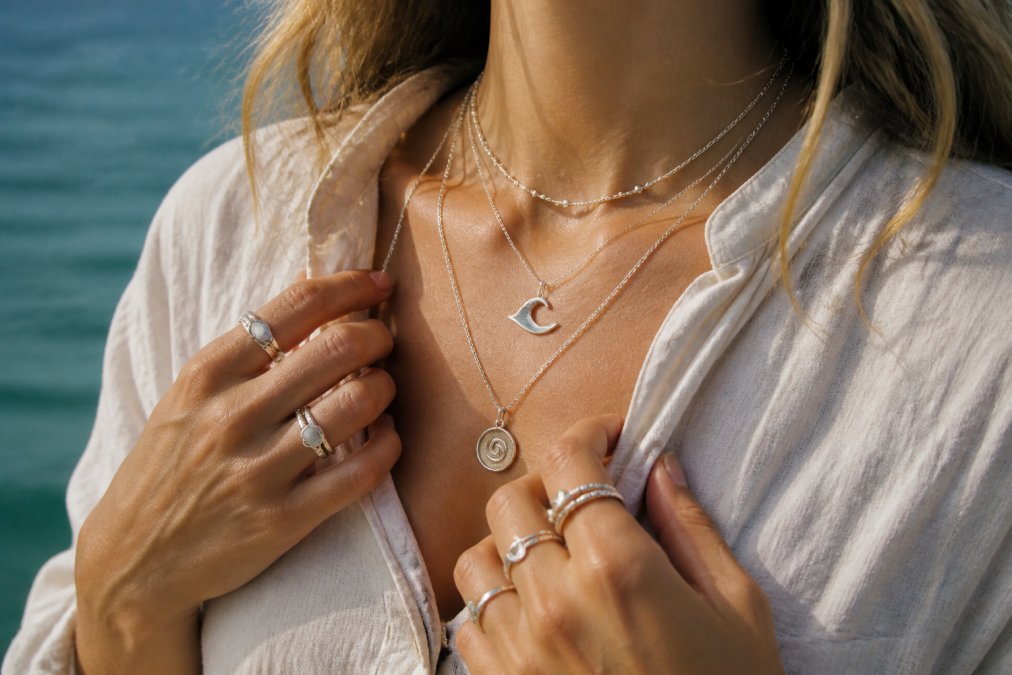
The best handcrafted silver rings are the ones you forget you're wearing, then catch in a mirror and remember. Silversmith Leila shapes each Inner Wild ring by hand, so no two are identical, slight variations in texture and finish prove a person made it.
Stackable rings work hardest here: a thin hammered band next to a wider oxidized piece creates contrast without bulk. If ocean-themed design feels too niche for work, a single minimalist band is subtle enough for a meeting yet distinctive enough that someone will ask where you found it.
A common mistake is sizing a whole stack at once from one brand. Buy one ring first, live with it for a week, then build around it.
Silver Necklaces and Pendants: Wearable Ocean Art
Pendant necklaces are where ocean-inspired silver design does its best work: a shell, wave, or tide-pool motif hangs at eye level and becomes the piece people notice first.
Layering is the whole game. A short chain with a small pendant sits at the collarbone; a longer chain with a statement piece drops below it. Keep them a couple of inches apart so they don't tangle, and mix chain styles, a fine cable next to a heavier link, so it looks intentional.
For gift givers, a pendant necklace is the safest meaningful choice. It fits nearly every neckline and doesn't require knowing a ring size.
Silver Earrings and Hoops for Everyday Wear
Silver hoops are the most versatile piece in any collection. Small hoops read polished and professional; larger hoops lean casual and retro. Owning one of each covers almost every outfit in a week.
The detail most shoppers overlook is weight. A hollow hoop looks substantial but feels light over a ten-hour day; solid hoops have more presence but can drag on the lobe by late afternoon. For a large hoop without the pull, choose a hollow or tubular construction.
Why sterling silver matters more for ears than anywhere else
Ear piercings are where metal choice stops being aesthetic and becomes a comfort question. The earlobe is thin skin with a piercing channel in constant contact with the metal, so whatever is in the alloy is against you all day.
Sterling silver is 92.5% pure silver (What is sterling silver?). The remaining 7.5% is an alloy, usually copper, added because pure silver is too soft to hold a shape or clasp. That alloy is where irritation comes from, and the most common culprit is nickel, common in budget jewelry and "silver-tone" pieces that contain no silver at all.
So the rule for sensitive ears: buy solid sterling silver and confirm the maker uses a nickel-free alloy. A "925" stamp tells you the silver content, not what the other 7.5% is, which is why a maker who states their alloy beats a listing that only shows a stamp.
What to look for on the listing
- A stated alloy, not just a stamp. "925 sterling silver, nickel-free" is a real claim. "Silver plated" or "silver tone" is a thin silver layer over brass or steel, and it wears through.
- Solid sterling posts and backs. The post sits inside the piercing, so it matters most. Gold-filled or sterling posts are the safe choice; mystery-metal posts are the risk.
- Screw backs or locking backs for daily wear. They cost more and stay on. Push backs are fine for a night out and easy to lose on a commute.
- Weight in the description. A maker who lists grams expects you to wear the piece, not just photograph it.
If your ears have already reacted
A common pattern is ears that were fine for years and then started reacting to cheap earrings.
For a daily-wear rotation, the safest base is two pairs of solid sterling hoops, one small, one medium, in a nickel-free alloy. Everything else can be chosen for looks.
How to Clean Sterling Silver Jewelry at Home
Learning how to clean sterling silver jewelry at home takes about five minutes and two things you probably already own. Tarnish is a surface reaction with sulfur in the air, not damage, so it comes off easily.
The safest method:
- Line a bowl with aluminum foil, shiny side up
- Add a tablespoon of baking soda and a teaspoon of salt
- Pour in hot (not boiling) water and lay the silver on the foil
- Wait two to three minutes, then rinse and pat dry
- Finish with a soft polishing cloth for shine
Before you clean it, confirm it's actually sterling
Here's the step most cleaning guides skip: the method above is for solid sterling silver. A foil bath won't hurt a plated piece, but polishing cloths and repeated cleaning will wear through the plating and expose the base metal, and once that happens, no amount of cleaning brings the silver back.
Matching the cleaning method to the piece
| Piece | Best method | Avoid |
|---|---|---|
| High-polish rings and bands | Polishing cloth, foil bath for heavy tarnish | Abrasive pastes, rough brushes |
| Oxidized or antiqued designs | Polishing cloth only, light pressure | Foil bath, liquid dips, ultrasonic cleaners |
| Chains and fine links | Foil bath, then pat dry and lay flat | Pulling or stretching while wet |
| Earrings with posts | Foil bath, then dry the post thoroughly | Leaving moisture in the piercing channel |
| Pieces with stones or pearls | Damp cloth on the metal only | Submerging the stone |
A note on ultrasonic and liquid dips
Jewelry-store ultrasonic cleaners and commercial silver dips are fast and work well on plain high-polish sterling, but both are aggressive. Dips strip oxidation, erasing the darkened recesses on an antiqued piece; ultrasonic cleaners can loosen glued-in stones. If a piece has intentional darkening or a stone you care about, cloth-and-foil is the safer default.
Styling Silver Jewelry for Everyday Wear
How to Store Silver Jewelry to Prevent Tarnish
Knowing how to store silver jewelry to prevent tarnish is the difference between a piece that stays bright for years and one that dulls in a drawer. Air, humidity, and sulfur do the damage, so limit exposure.
What works:
- Store each piece in an airtight zip bag with the air pressed out
- Add a small anti-tarnish strip to the bag or box
- Keep pieces separated so they don't scratch each other
- Store in a cool, dry spot away from bathrooms and kitchens
- Wear silver often; the oils in your skin actually slow tarnish
Frequently Asked Questions
How can you tell if silver jewelry is high quality?
Look for a hallmark stamp reading 925, sterling silver, or sterling. The 925 mark means the piece contains 92.5% pure silver, the standard for fine jewelry. Handcrafted pieces from small studios often carry a maker's mark alongside it. Weight and finish also tell you a lot: well-made unique silver jewelry feels solid in the hand, has smooth solder joints, and clasps that open and close without catching. If a piece is priced far below comparable sterling items, it is likely silver-plated rather than solid.
Is sterling silver still in style for modern jewelry collections?
Yes. Sterling silver has stayed a staple in contemporary design because it suits both minimalist and bold styles. A versatile silver piece can move from office wear to weekend styling without looking dated.
What are the benefits of choosing handmade silver jewelry over mass-produced pieces?
Handmade silver jewelry is made in small batches, so each piece carries slight variations in texture and finish that factory production cannot copy. You can often trace the maker, the sourcing, and the story behind the design. Many artisan studios also use recycled or responsibly sourced silver and support conservation causes. The trade-off is that restocks take longer and popular designs sell out, so if a piece catches your eye, it is worth buying when you see it rather than waiting.
How do you properly clean and maintain unique silver jewelry?
Wash your hands first, then use a soft polishing cloth or a mild dish soap and warm water solution with a soft-bristle brush. Rinse and dry completely before storing. Avoid abrasive cleaners, toothpaste, and chlorine, which strip the finish and speed up tarnish. Wear silver pieces after applying lotion, perfume, and hairspray, not before. For oxidized or antiqued designs, skip liquid dips, since they remove the darkened detailing that gives the piece its character.