

Best Sustainable Jewelry Brands 2026: A Data-Driven Guide
Table of Contents
- What Makes a Jewelry Brand Truly Sustainable in 2026
- How to Identify Sustainable Jewelry: A Buyer's Checklist
- Recycled Gold Jewelry Brands: What to Look For
- Lab-Grown vs Mined Diamonds Sustainability: The Data
- Top Sustainable Jewelry Picks for 2026
- Carbon Footprint, Repairability, and End-of-Life Recycling
- Conclusion: Making a Conscious Choice in 2026
- Frequently Asked Questions
Last Updated: September 18, 2026
What Makes a Jewelry Brand Truly Sustainable in 2026
Sustainability in jewelry is not a label you can print on a box. It is a set of verifiable practices across sourcing, labor, and production that a brand can prove with documents, not adjectives, a distinction that matters in 2026, when "eco-friendly luxury" has become one of retail's most abused phrases. This guide from Inner Wild Jewelry shows you how to judge the best sustainable jewelry brands 2026 has to offer using evidence instead of vibes.
The Five Pillars of Sustainable Jewelry
A credible sustainable jewelry brand usually demonstrates strength in five areas:
- Material sourcing: recycled gold, recycled sterling silver, and traceable gemstones
- Ethical labor practices: fair wages and safe conditions at every stage, including mining
- Environmental impact: reduced water use, lower carbon footprint, and responsible mining partnerships
- Supply chain transparency: public disclosure of where materials come from
- Longevity: repairable, heirloom-quality pieces designed to outlast trends
How to Identify Sustainable Jewelry: A Buyer's Checklist
Learning how to identify sustainable jewelry comes down to one habit: ask for proof, then verify it yourself. A brand that does the work can point to certifications, named suppliers, and third-party audits; a greenwashing brand answers with vague mission statements.
Certifications That Actually Matter
Third-party certification is the fastest way to separate real claims from marketing language, if you know what each standard verifies:
- Fairmined and Fairtrade Gold: These certify responsible mining and fair pay for artisanal and small-scale miners. Fairmined is administered by the Alliance for Responsible Mining; Fairtrade Gold by Fairtrade International. Both require third-party audits of the mine site, not just the brand.
- Responsible Jewellery Council (RJC) certification: Covers the full supply chain, from mine to retail, audited against the RJC Code of Practices. It is member-based, so a brand can be an RJC member without every product being certified, ask which entities hold it.
- SCS Recycled Content certification: Verifies recycled gold and silver claims by tracing the chain of custody. Ask for this when a brand says "recycled" without saying "certified recycled."
- Kimberley Process: The baseline standard for conflict-free diamond trade. It is government-level, not brand-level, so it confirms a shipment was not used to fund conflict, not that a diamond was mined responsibly environmentally or labor-wise.
How to Verify a Claim in Five Minutes
A certification logo is a starting point, not a finish line. A repeatable routine:
- Find the certification number or member ID. Reputable certifiers publish searchable databases. A badge with no ID is unverified.
- Check the scope. A brand may be certified for its gold but not its gemstones, or for one product line but not the whole catalog.
- Cross-reference the supplier. If a brand names its refiner or mine, that name should appear in the certifier's public records. If not, the chain has a gap.
- Look for a dated sustainability report. Specific numbers (recycled content percentage, water use, audit dates) are far harder to fake than a values page.
- Ask one specific question. "Which mine did the gold in this ring come from?" A verifiable brand can answer; a greenwashing brand will pivot to mission language.
Red Flags of Greenwashing
Greenwashing in jewelry follows recognizable patterns:
- Vague phrases like "ethically made" with no named supplier or standard
- "Conflict-free" diamonds with no mention of the Kimberley Process or traceability
- Sustainability pages that describe values but never mention materials
- No information about where gemstones originate
- "Eco-friendly" packaging presented as the main environmental effort
- A certification badge with no ID number, scope, or link to the certifier's database
- Recycled-content claims that do not specify certified or self-declared
When a brand cannot afford certification, ask for the next best thing: the name of the refiner or mine, the country of origin, and whether they have visited the site. Specificity is the tell. "Our supplier handles that" is the gap.
The Unique Angle: Verification Over Vibes
Most sustainable jewelry guides rank brands by how their mission statements read, which rewards copywriting over sourcing. Treat every claim as a hypothesis and ask what evidence would confirm it. A brand that welcomes that question, with certificate numbers, named suppliers, and dated reports, is doing the work; one that resists it is telling you something too.
Recycled Gold Jewelry Brands: What to Look For
Recycled gold jewelry brands source metal that already exists above ground rather than newly mined gold. Recycling avoids the land disturbance, water use, and mercury exposure of primary mining, and the gold is chemically identical, so you lose nothing in quality.
Lab-Grown vs Mined Diamonds Sustainability: The Data
The lab-grown vs mined diamonds sustainability comparison is jewelry's most misunderstood debate. Lab-grown diamonds are created in a lab using high pressure and heat, are chemically and optically identical to mined stones, and avoid the land disruption and labor concerns tied to extraction.
Ask a brand for the specific mine or region a gemstone came from. If they can name it, that is a strong signal. If the answer is "our supplier handles that," the traceability chain has a gap.
Top Sustainable Jewelry Picks for 2026
The best sustainable jewelry brands 2026 buyers should consider prove their claims at the material level. These picks focus on verifiable sourcing, repairability, and designs built to last.
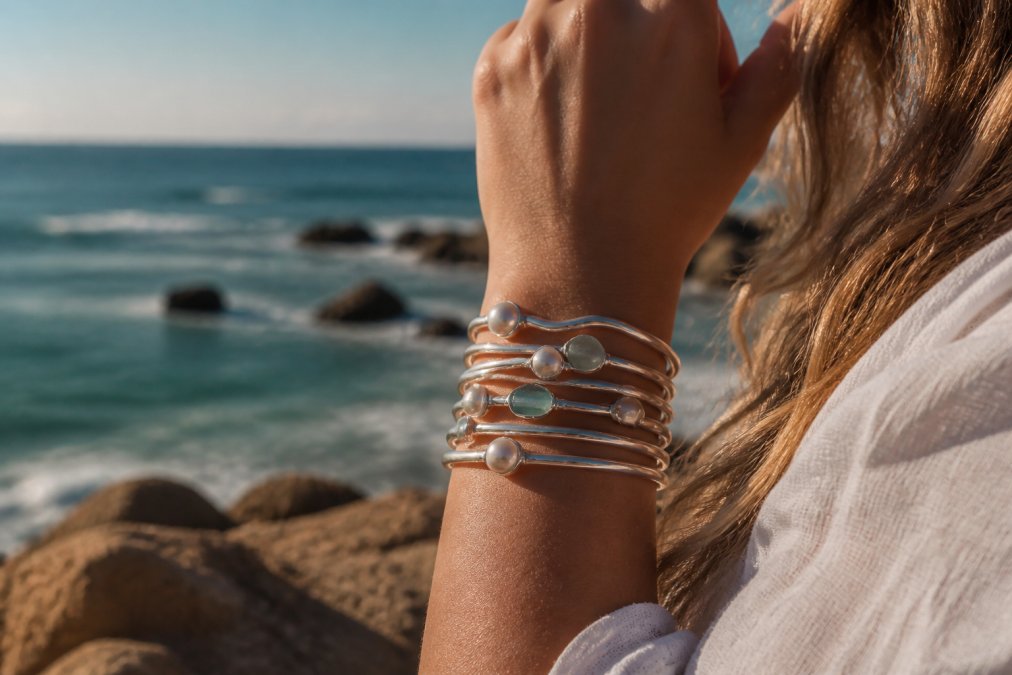
Handcrafted Silver and Gemstone Pieces
Inner Wild Jewelry is our top pick for ocean-hearted buyers who want handmade, non-factory pieces with a documented story. Every item is made to order by silversmith Leila, no speculative production, no deadstock waste.
| Piece | Price | Material | Best For |
|---|---|---|---|
| Ghost Tide Bangle | $60 | Freshwater pearl, sea glass or shell, sterling silver | Everyday layering |
| The Siren's Light Bangle | $60 | Freshwater pearl, sterling silver | Subtle daily wear |
| The Element Ring - Larimar | $75 | Larimar, sterling silver | Minimalist statement |
| Larimar + Moonstone Balance Ring | $100 | Larimar, moonstone, sterling silver | Meaningful gift |
Statement Cuffs and Ocean-Inspired Bangles
On price: handmade silver jewelry costs more because a person makes it one piece at a time. The tradeoff is a named maker, a real material story, and a design that does not exist in thousands of identical copies.
The Siren’s Depth Bangle | Tahitian →

Carbon Footprint, Repairability, and End-of-Life Recycling
Most sustainable jewelry guides stop at the point of sale, telling you what to buy and never what happens after. This section fills that gap: how to think about a piece's full life, from the energy that made it to the day you stop wearing it.
Carbon Footprint: Why the Comparison Is Hard and What You Can Still Compare
Carbon footprint comparison in jewelry is genuinely difficult: most brands do not publish emissions data, and existing figures are not measured the same way. A lab-grown and a mined diamond, for example, are often compared using different system boundaries, one study counts only the growth reactor, another the mine plus cutting and polishing. Hence the wildly different numbers cited for the same category.
- Made-to-order vs. mass production. A piece made after you order it avoids the emissions tied to overproduction and unsold inventory. Mass-produced jewelry that ends up discounted or destroyed carries that wasted energy in its footprint.
- Recycled vs. newly mined metal. Recycled gold and silver skip the extraction stage entirely, where a large share of a metal's environmental impact occurs. Refining and fabrication energy still applies, but the mining footprint does not.
- Local vs. long-distance supply chains. Shipping is a smaller slice than mining or refining, but not zero. A piece made and shipped within one region has a shorter transport footprint than one crossing multiple continents.
Repairability: The Metric Most Buyers Overlook
Repairability is the most underrated sustainability metric in jewelry: a piece you keep for thirty years has a fraction of the annual impact of one you replace every three. The question is not "is this sustainable?" but "can this be fixed?"
What makes a piece repairable:
- Solid metal, not plating. A solid sterling silver or gold piece can be resized, re-polished, and re-soldered. A plated or vermeil piece cannot be repaired once the plating wears through, the base metal is exposed and the piece is effectively finished.
- Simple, accessible settings. A bezel-set or flush-set stone is easier to re-tighten than a complex pavé setting with dozens of tiny stones.
- A maker who offers repair. Some studios repair their own work for life; others do not. Ask before you buy.
- Classic design over trend design. A silhouette that does not date is more likely to stay in rotation, the real longevity win.
End-of-Life Recycling: Closing the Loop
End-of-life recycling is where most guides go silent, and where jewelry's circular economy actually lives. Sterling silver and gold retain their value and can be melted and re-formed indefinitely without losing quality, so a piece you no longer wear is not waste, it is feedstock.
- Ask the maker first. Some studios offer trade-in, buy-back, or recycling programs. A maker who will take back their own work is running a closed loop, the strongest version of circularity.
- Sell or trade to a refiner. Precious metal refiners buy scrap silver and gold by weight and recycle it into new stock. This is the most common path for metal with no sentimental or resale value.
- Donate to a jeweler who reworks. Some independent jewelers accept old pieces and rework the metal into new designs, keeping material in circulation without a full melt-down.
- Avoid the trash. A silver or gold piece in a landfill is a wasted resource. Even a broken chain has recoverable metal value.
The full-life view changes what "sustainable" means. A piece made from recycled silver, built to be repaired, and recyclable at the end of its life has a fundamentally different footprint than a trend piece that is worn for a season and discarded. Ask about all three stages, production, repair, and end-of-life, before you buy.
The Unique Angle: Longevity as the Real Sustainability Metric
Carbon numbers are useful but incomplete, and most brands will not give you one. Longevity is the metric you can actually evaluate: a piece that is repairable, made from solid recycled metal, and backed by a maker who will take it back at end of life does more for the circular economy than a glossy sustainability page with no repair policy.
Conclusion: Making a Conscious Choice in 2026
The hardest part of conscious consumerism in jewelry is that the loudest sustainability claims are often the least verifiable. The fix: stop reading mission statements and start asking for material origins, certifications, and repair options.
Frequently Asked Questions
Which jewelry brands are considered the most sustainable?
The most sustainable jewelry brands share key traits: they use recycled gold or sterling silver, source conflict-free stones, and provide supply chain transparency. Look for third-party certifications like Fairmined or SCS Global Services. Brands that offer repair programs and take back old pieces for recycling score higher. Small-batch makers who handcraft pieces to order, like those using recycled metals and responsibly sourced gemstones, often have a lower environmental impact than mass producers because they avoid overproduction and excess inventory.
How can I verify if a jewelry brand is truly ethical?
Start by checking for third-party certifications such as Fairmined, Fairtrade, or SCS Global Services. Look for a published sustainability report or supply chain page that names specific mines, refineries, or recycling partners. Vague language like 'eco-friendly' without proof is a red flag. You can also search the brand's name alongside 'greenwashing' or 'certification' to see if watchdogs have flagged issues. Finally, ask the brand directly where their metals and stones come from. Transparent brands answer clearly; others deflect.
Is recycled gold better for the environment than mined gold?
Yes. Recycled gold avoids the environmental damage of mining, which can involve habitat destruction, water pollution, and high energy use. It also keeps existing gold in circulation, supporting a circular economy. When shopping, look for brands that explicitly state their gold is recycled and ideally certified by a third party. Recycled gold has the same purity and durability as mined gold, so there is no quality trade-off.
What should I look for when buying eco-friendly jewelry?
Check for recycled metals (gold, silver, platinum), lab-grown or conflict-free gemstones, and transparent sourcing. Look for certifications like Fairmined or SCS. Ask about the brand's carbon footprint and whether they offer repair or take-back programs. Handmade, made-to-order pieces reduce waste from overproduction. Also consider longevity: timeless designs and repairable construction mean you keep the piece longer, which lowers its lifetime impact. Finally, see if the brand donates to environmental causes, and verify those claims on their site.
How does the carbon footprint of lab-grown diamonds compare to mined diamonds?
Lab-grown diamonds typically have a much lower carbon footprint. Mined diamonds can generate several times more carbon emissions per carat. However, lab-grown production is energy-intensive, so the source of electricity matters. A lab-grown diamond made with renewable energy has a smaller footprint than one made with coal power. Always ask the brand for specifics.