

90s Beach Aesthetic Jewelry Trends: 7 Styles to Wear
Table of Contents
- Why 90s Beach Jewelry Still Shapes Summer Style
- The 90s Jewelry Trends That Started at the Shoreline
- The 90s Choker Necklace: Lace, Cord, and Colored Metal
- The 90s Shell Necklace and Other Coastal Icons
- Summer Necklace Layering: The 2:1:1 Rule and Beyond
- Hoop Earrings, Charm Bracelets, and Statement Cuffs
- Materials, Durability, and Care for Beach Jewelry
- Sourcing 90s Beach Jewelry You Can Feel Good About
- Frequently Asked Questions
Last Updated: October 12, 2026
Why 90s Beach Jewelry Still Shapes Summer Style
The 90s beach aesthetic jewelry trends never really left. They went quiet, then came back stronger, and in 2026 they are the fastest-moving look in summer accessories.
That instinct is worth trusting. The 90s beach look was never about diamonds or designer labels.
The trends below share one trait: cheap to buy, easy to layer, and impossible to take too seriously.
The 90s Jewelry Trends That Started at the Shoreline
Most 90s jewelry trends did not start in fashion houses. They started on boardwalks, in souvenir shops, and on the wrists of surfers who needed something that could survive salt water.
From Boardwalk Stalls to Runway Revivals
The 90s beach aesthetic grew out of a summer economy where boardwalk vendors sold shell necklaces, cord chokers, and beaded strands to anyone with a few dollars.
Designers noticed, and the same pieces that cost a few dollars at a beach stall reappeared on runways a few seasons later. Today the revival runs on nostalgia and better materials.
The 90s Choker Necklace: Lace, Cord, and Colored Metal
The 90s choker necklace is the most recognizable piece of the era. It sat close to the throat on a thin cord or stretchy band and worked with everything from tank tops to slip dresses. What roundups rarely explain is why it worked and how to keep it from reading as a costume today.
Three versions dominated:
- Lace chokers in black or white, often with a small pendant. The stretch lace version was the most common because it needed no clasp and fit almost any neck.
- Cord necklaces on waxed thread, sometimes with a single bead. Waxed cotton held a knot well and survived sweat and salt better than untreated string.
- Colored metal bands in silver-tone and gold-tone finishes, usually on a thin wire or a stiff collar shape.
Why the Choker Reads as Beach, Not Costume
The choker's beach connection is practical. A short, close-fitting band stays out of the way when you swim, paddle, or lean over a towel, and it does not swing into your face like a long pendant.
The costume problem shows up when proportions are wrong. A wide band plus a large pendant plus heavy layering reads as a specific decade.
Fit and Neckline Mechanics
A choker is the one necklace where length matters more than the pendant. Most people land between 14 and 16 inches for a true choker fit, and 16 to 18 inches for a choker-adjacent look above the collarbone.
Neckline choice changes the effect more than the choker itself:
- Crew and high necklines: a thin choker adds a clean line and keeps the neck from looking cut off.
- V-neck and scoop necklines: a choker fills the open space at the top, which is why it paired so well with tank tops in the 90s.
- Off-shoulder and strapless: a choker draws the eye up and balances the bare shoulder line.
If you want a modern version of the same idea, a pendant on a short cord does the job. Our Tempest Halo Necklace pairs a fossilized shark tooth with sea-green Amazonite on an 18" sterling silver chain, which lands right at that classic choker-adjacent length.
The 90s Shell Necklace and Other Coastal Icons
The 90s shell necklace is a strand of shells, usually puka or cowrie, threaded on cord and worn loose against the chest. It is the most literal piece of the beach aesthetic and the most nostalgic.
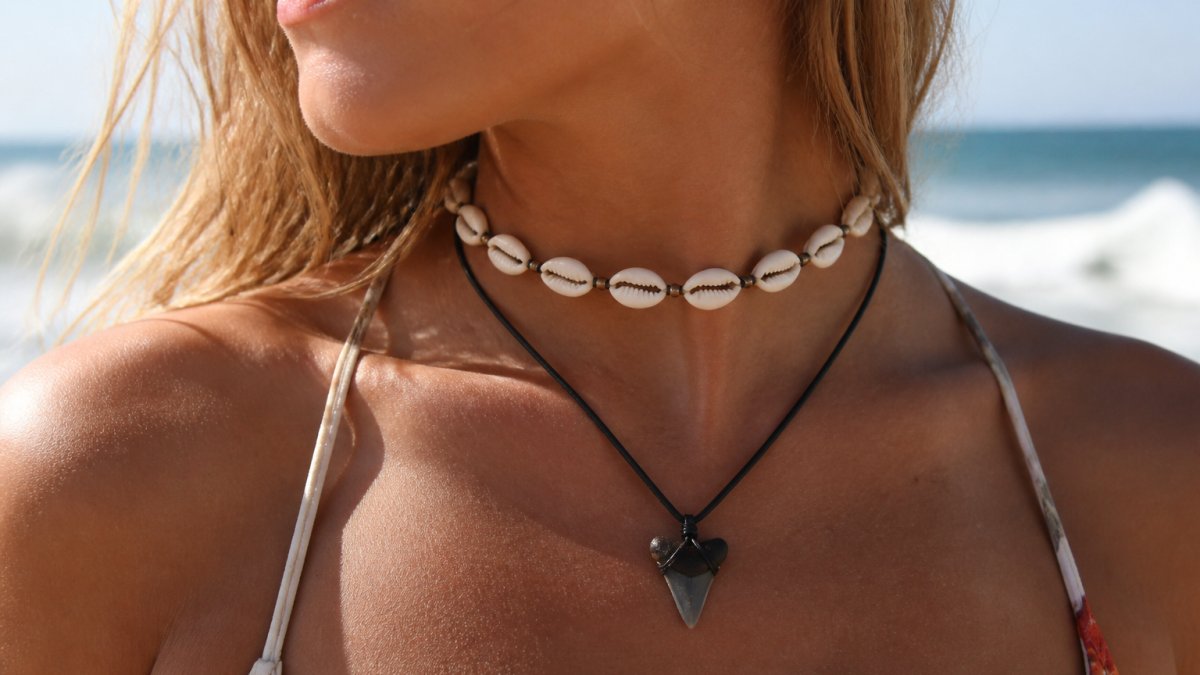
Puka Shells, Cowrie Shells, and Shark Tooth Pendants
Each shell carried its own meaning.
- Puka shells signaled surf culture. Small, white, and uniform, they were the surfer's default necklace.
- Cowrie shells had a warmer, more bohemian feel and showed up on longer strands.
- Shark tooth pendants were the trophy piece, worn by anyone who wanted to look like they had actually been in the water.
That last category has aged best. A shark tooth is a real fossil with real texture, reading as jewelry rather than souvenir. Our Tempest Halo Necklace sets a fossilized shark tooth and iridescent abalone inside a handcrafted silver circle, on a 20" black braided leather rope with a snap clasp.
Summer Necklace Layering: The 2:1:1 Rule and Beyond
Summer necklace layering works best with a simple ratio: two short chains, one medium, one long.
Here is how it breaks down in practice:
| Layer | Length | What to Wear There |
|---|---|---|
| Short (x2) | 16-18 inches | Choker or fine chain with a small pendant |
| Medium | 20-24 inches | Shell strand or single bold pendant |
| Long | 26-30 inches | Beaded strand or open lariat |
The two short layers read as one visual unit, the medium layer is your focal point, and the long layer adds movement.
One rule matters more than the ratio: vary the weight. Two heavy pendants will clatter and twist, so pair one substantial piece with thinner chains around it.
Hoop Earrings, Charm Bracelets, and Statement Cuffs
Hoop earrings and charm bracelets made the 90s beach look feel playful rather than precious. Both are back and easier to wear now.
Bite Club - Stamped & Sharky →
Hoop earrings came in every size, from tiny huggies to oversized gold-tone rings.
Charm bracelets were the storytelling piece, you collected charms and each one meant something. The 90s version jingled; the modern version often skips the jingle for a cleaner line.
For a beach-specific take on the same idea, a stamped cuff does the work of a charm bracelet without the noise. Our Bite Club cuffs are sterling silver with sustainably sourced fossilized shark teeth, and every purchase supports shark conservation and research. The Bite Club - Stamped & Sharky cuff measures 4 3/4" with a 1" gap, sized for wrists around 5 3/4", and carries sun ray stamping around a blueish-grey tooth with a textured tan root.

Smaller wrists have options too. Bite Club - Small Suns measures 4 1/2" with a 1" gap for wrists around 5 1/2", and Bite Club - The Classic is the same size with sea shell stamping and a dark grey tooth. If you want the piece to be the whole outfit, Bite Club - The Big One sets a 1 1/4" smooth black shark tooth on a double hammered cuff band, sized for wrists around 6 1/4".


Materials, Durability, and Care for Beach Jewelry
Knowing what you are buying solves most of the problem before it starts.
Sterling Silver, Gold-Tone, and Salt Air
Sterling silver is the standard for handmade ocean jewelry and holds up well with basic care. It tarnishes over time, which is normal and reversible.
Gold-tone jewelry is base metal with gold-colored plating. It looks right and costs less, but the plating wears through with repeated exposure to salt, sunscreen, and chlorine.
Solid gold resists tarnish best but costs the most, which is why most beach pieces skip it.
A few care habits extend the life of any of these:
- Rinse pieces in fresh water after a day at the shore, then dry them with a soft cloth
- Put jewelry on after sunscreen and lotion, not before
- Store pieces in a dry pouch or box rather than loose in a bag
Sourcing 90s Beach Jewelry You Can Feel Good About
Sourcing matters more here than in most categories. Modern buyers want the same look without the same waste.
Where to Actually Find Pieces
There are four realistic channels, each with a different trade-off:
- Thrift and consignment stores. The cheapest route to genuine 90s pieces. Selection is unpredictable, and you may need several visits before you find anything worth buying. Look in the costume jewelry case near the register, not just the display racks.
- Estate sales and local auctions. Often the best source for older shell and cord pieces that were worn once and stored. Arrive early; jewelry moves first.
- Online resale marketplaces. The widest selection and the easiest to search by keyword, but you are buying from photos. Ask for close-ups of the clasp, the cord, and any stamp on the metal before you commit.
Telling Authentic Vintage From Modern Revival
A genuine 90s piece and a modern revival can look identical in a photo.
- Clasps. 90s costume pieces often used a simple spring ring, a barrel clasp, or a stretch band with no clasp at all.
- Cord and string.
- Metal stamps. A "925" or "sterling" stamp points to real silver. A "gold-tone" or plated piece from that era will usually show wear at the high points where the plating has rubbed off.
What to Check Before You Buy
Three questions sort most listings quickly:
- Who made it? Handmade pieces carry a maker's name. Factory pieces do not.
- What is it made of? Sterling silver, real shell, and genuine fossil are worth the higher price. Plated base metal is not.
- Where does the money go? If a brand claims conservation support, look for a specific statement about what is funded.
That third question is the one most brands answer vaguely, and the one that separates a real commitment from a marketing line.
Care and Repair for Secondhand Pieces
Sterling silver that has gone dark can be brought back with a soft polishing cloth.
We built Inner Wild Jewelry around the answer to that third question. Every piece is handmade by our silversmith Leila, nothing is factory-made, and our Bite Club pieces are sterling silver with sustainably sourced fossilized shark teeth, with every purchase supporting shark conservation and research. The Bite Club - The Sandy Tooth cuff is a good place to start if you want the summer-in-a-cuff version: a hammered band, a serrated bezel, and a tan and grey tooth with a root that looks like sand.
For a lighter piece, the Ghost Tide Bangle pairs a freshwater pearl with sea glass or a sea shell on a handmade sterling silver bangle. It is made to order, with a turnaround of 2-3 weeks, and it layers easily with a stack of thin chains.
Frequently Asked Questions
What jewelry was popular at the beach in the 90s?
The 90s beach jewelry scene ran on shell necklaces, thin cord chokers, hoop earrings, beaded strands, and charm bracelets. Puka shell necklaces and cowrie shell pieces were everywhere, often paired with mood rings and leather straps. Layering was common: a short cord choker worn with a longer shell or shark tooth pendant. Today's 90s beach jewelry revivals keep those same silhouettes but swap cheap base metals for sterling silver and sustainably sourced materials, so pieces last beyond one summer.
Were shell necklaces popular in the 90s?
Yes. Shell necklaces, especially puka and cowrie styles, were one of the defining accessories of 90s beach fashion. They showed up on boardwalks, in music videos, and on nearly every coastal postcard. The 90s shell necklace look is easy to recreate today: choose a single shell or shark tooth pendant on a cord or silver chain and let it sit against bare skin or a simple tank. Handmade versions in sterling silver hold up far better than the string-and-shell versions from decades past.
How do you style 90s-inspired beach jewelry for everyday wear?
Start with one statement piece and build around it. A shark tooth cuff like the Bite Club stacker cuffs ($155) works with a white tee and jeans as easily as a sundress. For necklaces, try summer necklace layering with a short choker and a longer pendant, keeping the metals consistent. If bold pieces feel like too much for work, choose a smaller cuff or a single pendant on a thin chain. The 90s aesthetic reads as intentional when you limit yourself to two or three pieces at once.
Are 90s jewelry trends back in style in 2026?
They are. Chokers, hoop earrings, layered necklaces, and charm bracelets have all cycled back into mainstream fashion, and the 90s beach aesthetic has its own following among people who want nostalgic, coastal-inspired accessories. What separates the current revival from the original era is materials: buyers now look for sterling silver, recycled or sustainably sourced components, and handmade construction instead of disposable costume pieces. That shift means the trends look the same but wear far better.